How to Start Homeschooling: A Step-by-Step Guide
Thinking about homeschooling but not sure where to start? This complete step-by-step guide is designed just for new families navigating the early days of homeschooling. From understanding the legal requirements and choosing a homeschool style to setting up your space and building confidence, this guide breaks it all down in simple, encouraging steps. Whether you’re feeling excited or overwhelmed, you’ll find practical advice, real-life examples, and the support you need to begin your homeschool journey with clarity and courage.

If you’re new to homeschooling, you’re probably feeling a mix of excitement and fear.
Maybe you’ve caught yourself thinking, “Can I really do this?” or worrying that you’ll somehow “mess up” your child’s education. Deep breath, friend—you’re not alone, and those feelings are completely normal. Starting something new—especially something this meaningful—comes with a swirl of emotions.
But here’s the truth: You’re here because you want the best for your child. Maybe that means more freedom, a gentler learning pace, deeper family connection, or a safer environment. Whatever your reasons, you’re stepping into something powerful. And you’re not the only one. Homeschooling is growing every year—with about 3.7 million students in the U.S. now learning at home. That’s millions of families who’ve chosen this path too. ❤️
So consider this guide your cozy coffee date with a seasoned homeschool mom who’s been exactly where you are—curled up late at night, Googling “how to start homeschooling,” feeling hopeful but also completely overwhelmed. I get it.
The good news? Starting homeschool doesn’t have to be a giant leap into the unknown. Here, we’ll break it all down into clear, doable steps. By the end, you’ll have a beginner-friendly roadmap and the confidence to take that first step forward—without the stress.
(Ready? Let’s walk through it together, step by step.)
✅ Step 1: Embrace Your Decision and Know Your “Why”
Before anything else—pause and celebrate. 🎉 You’ve made a bold and beautiful choice to homeschool. Whether it’s for a more personalized education, a slower family rhythm, concerns about the school environment, or to support your child’s unique needs—your “why” matters. Hold onto it. Write it down. Stick it on your fridge or tuck it into your planner. On hard days (because yes, they will come), revisiting your “why” will remind you why this path is worth it.
💛 It’s normal to feel nervous.
Maybe you’re thinking, “I’m not patient enough.” Or, “What if I don’t know enough to teach them?” Maybe your family and friends are raising eyebrows. Those worries? Completely normal. Every homeschool parent starts out with doubts. Even the seasoned ones have off days where nothing seems to go right. Give yourself grace—you’re learning too.
💬 Talk it through as a family.
Homeschooling isn’t just your journey—it’s your family’s. If you have a partner, sit down and share your hopes, fears, and what homeschooling could look like together. Involve your kids in an age-appropriate way. Ask what they’re excited about or nervous to try. Getting everyone on the same page turns this into a team adventure, not just a solo mission.
🌱 There’s no “right way” to homeschool.
The beauty of homeschooling is flexibility. Learning can happen at the kitchen table, sprawled on the couch, or outside in the sunshine. Your homeschool day might start at 8 a.m.—or not until after lunch. It might be fueled by books and worksheets or full of projects and nature walks. And that’s the point. You don’t have to mimic public school. You get to build something that fits your family.
📌 Pro Tip: Take a few minutes this week to jot down your “why.” Keep it in a place you’ll see often—especially on the days when doubt creeps in. That reminder can be a powerful anchor.
✨ In short: You’ve made a courageous decision. Own it. Trust yourself. Your confidence will grow with each small step forward—and you’ve already taken the first one.
✅ Step 2: Learn the Homeschooling Laws and Handle the Paperwork
📌 Before you dive into lesson plans and library trips, let’s take care of the legal stuff.
Homeschooling is legal in all 50 U.S. states (and many other countries), but the rules can vary quite a bit depending on where you live. Don’t let this intimidate you—it’s usually simpler than it sounds, and once you do it, it’s mostly out of the way.
🔍 Find out what your state requires
Some states ask you to file a notice of intent, others might want an end-of-year assessment or specific subjects to be covered. A few states have minimal requirements. You don’t need to become a legal expert—we’ve got you covered. You can check our HSLDA’s state law map for a quick reference.
📝 If your child is enrolled in school, send a withdrawal notice
If your child is currently attending public or private school, you’ll need to officially withdraw them. This usually means submitting a short letter or form to your school or district. It’s often called a letter of withdrawal, and templates are widely available online.
✅ Pro Tip: Call your school’s front office or check your state’s homeschool association website for the exact steps.
If your child has never been enrolled (like starting with kindergarten), you may not need to do this—but some states still ask for a first-year notice. Again, check the rules for your area to be sure.
📁 Keep any required records (without overcomplicating it)
A few states require homeschoolers to track attendance, immunizations, or maintain a portfolio of student work. Don’t panic—you don’t need a filing cabinet.
A simple binder or folder for each child works great. You can stash in:
- Sample work from different subjects
- Reading lists
- A log of days you “did school”
- Progress notes or report cards (if required)
✅ Pro Tip: Set a reminder in your calendar for any yearly reporting deadlines. Once you’ve handled the setup, you can “set it and forget it” until those dates pop up.
🙌 Know your rights—and homeschool with confidence
You absolutely are allowed to homeschool. If someone questions your decision or says, “Is that even legal?” you can confidently say yes—you’ve followed all the rules and taken the right steps.
Thousands of families start homeschooling each year. If they can do it, you can too. And once the paperwork’s done? You’re free to focus on the fun, meaningful parts of this journey—building connection and creating a learning life together.
🎉 Go ahead and give yourself a pat on the back. You’ve checked off the legal boxes—now let’s move on to the good stuff!
✅ Step 3: Deschool and Allow Time to Adjust
📌 Before you dive into curriculum and lesson plans, take a deep exhale.
It’s time to deschool—a fancy word for something incredibly important: giving yourself and your child time to shift out of the traditional school mindset and into a new rhythm of learning.
💭 What is deschooling?
Deschooling is like a decompression period. If your child attended conventional school, they’re used to bells, strict routines, and doing things a certain way “because that’s how school works.” Deschooling gives them (and you!) space to let go of those old habits and discover how learning can be joyful, flexible, and deeply personal.
You can read this to learn more about deschooling and how to get started.
😅 “But we just started—shouldn’t we be doing school?”
It might feel strange to say, “We’re homeschooling now!” and then… not immediately jump into math worksheets. But imagine leaving a high-stress job to start something new—you’d probably take a little break, right? Same idea here.
Use this time to:
- Take nature walks or day trips
- Visit the library and let your child choose whatever books interest them
- Play board games
- Cook or bake together
- Do art projects or watch documentaries
- Just relax and enjoy some free play
Trust me—learning is happening in all of it.
🌱 Deschooling is for parents too
Chances are, you’ve got your own internal picture of what “school” is supposed to look like: desks, schedules, worksheets, structure. It’s easy to unconsciously try to replicate a classroom at home. Deschooling lets you step back and observe—how does your child naturally learn? What sparks their curiosity?
Maybe your child discovers a love for drawing, writing stories, or digging in the garden. There’s no test at the end of deschooling—just a mental and emotional reset.
⏳ How long should deschooling last?
A common rule of thumb is about one month for every year your child was in school. But this isn’t a hard rule. Some kids need a few weeks; others might need a whole summer. Let your child’s cues guide you.
- If they’re asking to start a math program? Go for it.
- Still decompressing from burnout? Give them time.
- Somewhere in between? Ease in gently with low-pressure activities.
✅ Pro Tip: Keep a journal during this time. Write down what your child explores, what lights them up, and how they spend their days. It’s amazing what you’ll learn just by observing.
Step 4: Explore Homeschooling Methods and Choose Your Style
📌 Once you’ve taken time to decompress, you’ll start noticing what makes your child light up.
This is the perfect moment to explore different homeschool methods and find a style—or a blend—that fits your family’s unique rhythm.
There’s no one-size-fits-all in homeschooling. And that’s the beauty of it! You get to design an educational approach that honors your child’s learning style, your teaching preferences, your family’s schedule, and even your values.
🧭 Popular Homeschool Styles to Explore:
📚 School-at-Home (Traditional)
This mirrors a public school setup with structured curriculum, textbooks, and a daily schedule. It’s familiar (especially for new homeschoolers), but can feel a bit rigid over time.
🌱 Unschooling
Completely child-led and interest-driven. No formal curriculum—learning happens organically through play, conversation, exploration, and real-life experiences. (Yes, kids really do learn math baking cookies and history through video games!)
🏛️ Classical Education
Structured around the three stages of learning (grammar, logic, rhetoric). Focuses on deep reading, memorization, Latin, logic, and classic literature. Think Socrates, timelines, and rich discussion.
📖 Charlotte Mason
Emphasizes “living books” (not textbooks), short lessons, nature study, art, and lots of narration. It’s a gentle, literature-rich method that values beauty and habit training.
🧩 Montessori & Waldorf
These originated in schools but adapt beautifully at home.
- Montessori uses tactile, self-directed learning tools.
- Waldorf emphasizes rhythm, creativity, handwork, and imagination—with a strong connection to nature.
🔀 Eclectic Homeschooling
A popular end-point for many families—you mix and match what works best from different methods. Unit studies, gameschooling, workbooks, outdoor learning—it’s all fair game!
👉 If you’re drawn to deep conversations and critical thinking, you might enjoy using the Socratic Method in Homeschooling to spark meaningful dialogue with your kids.
💡 Don’t feel overwhelmed—feel empowered.
This isn’t a quiz you have to get right. Choosing a homeschool style is just a starting point. You can shift, tweak, or completely change paths anytime.
👪 Think about your family’s personality
Are you a checklist-loving planner or a go-with-the-flow type?
Does your child crave structure, or thrive in bursts of interest?
Are they hands-on? Visual learners? Audio lovers?
There’s no wrong answer. The “right” homeschool style is the one where your child is growing and your family feels supported—not stressed.
📌 Real-Life Example:
A mom I know started with a classical curriculum because she loved the structure and literature. But her 7-year-old son? Totally miserable. He needed movement, creativity, and flexibility. So they switched to an eclectic mix with project-based learning and interest-led rabbit trails. Suddenly, homeschool was fun—for both of them.
That shift didn’t mean she failed—it meant she adjusted. And that is the real homeschool superpower.
👉 Not sure whether a unit study or a traditional curriculum is the better fit? Here’s a breakdown that compares both approaches so you can decide what works best for your family: Unit Study vs. Traditional Curriculum
💛 Bottom line:
Explore your options. Try one on. Adjust as you go.
Homeschooling isn’t about getting it perfect—it’s about growing together.
There are so many “right ways” to homeschool.
Your job is to find the one that feels right for you.
Step 5: Plan Your Homeschool Year (Curriculum and Routine)
📌 Now that you’ve got a feel for your homeschool style, it’s time to make a simple plan.
Even if you’re not a “planner,” don’t worry—this doesn’t have to be overwhelming or rigid. Planning is just about creating a flexible framework for what you want your child to learn and how your days might flow.
Let’s walk through it step by step. ☕🖊️
📚 Choose Your Curriculum or Resources
“Curriculum” can mean anything from a full boxed set to a Pinterest board full of free printables. What you use depends on your style and comfort level.
Here are a few common options:
- Boxed Curriculum: Great for your first year if you want everything laid out. (There are secular and faith-based options.)
- Mix-and-Match: Many families use one publisher for math, another for language arts, etc.
- Unit Studies or Interest-Led: Plan your own studies based on your child’s curiosity—space, dinosaurs, fairy tales, etc.
- Free & Low-Cost Resources: Library books, YouTube, educational websites, nature walks, and printable worksheets can take you a long way.
✅ Pro Tip: You don’t need to buy a full curriculum for every subject. Many families use formal curriculum just for reading and math, and let science, art, or history flow from real-life experiences, books, and play.
🗓️ Map Out a Yearly or Semester Plan
You don’t need to plan every single week—just a rough outline is enough!
Try this:
- Mark important dates: vacations, holidays, co-op meetups.
- Decide on a start date (and maybe an end date).
- Set simple goals:
– “Finish Level 2 math by December”
– “Read 5 chapter books by spring”
– “Do an Ancient Egypt unit in September”
Keep it flexible! These goals are a compass, not a contract.
👉 If you’re leaning toward unit studies, here’s a roundup of my Top Resources for Planning Unit Studies to help you get started with confidence.
📆 Create a Gentle Daily or Weekly Routine
Notice we said routine, not schedule. 😄
Here’s a sample gentle rhythm:
- Morning: Breakfast + chores, then math and reading/language arts
- Midday: Lunch + free play or outdoor time
- Afternoon: Science, history, or a fun elective (like art or coding)
- Anytime: Family read-aloud or open discussion time
Adapt it to your family’s natural flow:
- Do your kids focus better in the morning or after lunch?
- Do you like theme days? (e.g., “Math Monday,” “Field Trip Friday”)
- Do you need wiggle breaks or quiet time?
If you have teens, they might prefer sleeping in and doing work later. Little ones might need play breaks every 15 minutes. Your routine can be as loose or structured as you like, but having some predictability helps kids know what to expect each day. It also helps you ensure you’re touching on the subjects you want to cover.
✅ Pro Tip: If your schedule feels like a straitjacket, loosen it up. Kids thrive with rhythm, not rigidity.
👉 Want to map out your first themed unit? Here’s a guide on How to Plan a Unit Study step by step.
🚫 Don’t Overschedule
Especially in your first year—less really is more.
It’s so tempting to sign up for all the things: co-ops, clubs, sports, Spanish, piano… But that can lead to burnout fast.
Start small:
You can always add more as you find your groove
Focus on the core three: reading, writing, and math
Add one or two extras that feel exciting
🕷️ Leave Room for Rabbit Trails
Let’s say today was supposed to be a fractions lesson…
But your child found a weird spider in the backyard and asked a million questions. Boom: spontaneous science unit!
That’s the beauty of homeschooling. You can pivot, dive deep into passions, and still circle back to math tomorrow.
✅ Pro Tip: Keep a little margin in your day for wonder and flexibility.
🔄 Plans Are Not Set in Stone
Every veteran homeschooler will tell you: plans change. That’s not failure—it’s just real life.
If something isn’t working…
- Switch up the curriculum
- Adjust your routine
- Take a break and reset
Homeschooling gives you that freedom. Embrace it.
Step 6: Set Up Your Homeschool Space and Gather Your Resources
📌 Let’s talk homeschool setup—but don’t worry, this isn’t about creating a Pinterest-perfect classroom with color-coded bins and an apple-scented diffuser (unless that makes you happy, of course 😉). You truly don’t need a picture-perfect setup or a thousand dollars’ worth of curriculum to homeschool well. What you really need? A space that works for your family, a handful of basic supplies, and a whole lot of love and flexibility.
Create a learning environment that fits your real life.
Some families have a dedicated schoolroom with desks, maps, and cubbies. That’s awesome—if you have the space and want that vibe. But for most of us? Homeschool happens at the dining table, on the couch, on the porch, or sprawled out on the living room floor with a clipboard. You might do morning math at the table and read-alouds snuggled up on the couch. Science experiments in the kitchen, handwriting on the patio. It all counts. Think about where your kids feel focused and relaxed, and build from there.
💡 Real-life example: I know a family of six who has no schoolroom at all. They keep books in a bin and rotate around the house all day—math at the kitchen counter, reading on the trampoline, and art projects on the driveway. It works beautifully because it fits their lifestyle.
Start with the basics (and skip the shopping spree).
It’s easy to go overboard on supplies (ask me about the unopened science kits still haunting my closet 😅), but here’s what you actually need to start:
- Pencils and notebooks
- Crayons or markers
- Scissors and glue
- A library card and a reliable internet connection
- Any books or materials from your chosen curriculum (if you’re using one)
That’s it. Truly. If you’re on a budget, don’t stress—many families homeschool successfully on a tight income. You can use secondhand books, printable worksheets, thrift store finds, and tons of free online resources. There are also Facebook groups and homeschool communities that swap or share curriculum for free. Check out our post on What You Really Need to Start Homeschooling (Not Just Supplies) for a breakdown of essentials vs. extras—it might save you a cart full of things you’ll never use.
Organize in a way that makes sense for you.
There’s no gold star for alphabetizing your art supplies (promise). Just find a system that keeps things from getting lost. Some ideas:
- A bin or basket for each child’s daily work
- A shelf divided by subject (math/science on one side, reading/history on the other)
- A binder or planner for your own records and weekly plans
- A checklist or assignment book for older kids to encourage independence
✅ Pro Tip: If your kids know where to find their supplies and where to put them back, you’ll save yourself SO much time and sanity.
Prep your tech (if you’re using any).
If you’re using a laptop, tablet, or online curriculum, now’s a great time to check that everything’s working. Set up logins, bookmark frequently used sites, and maybe create a “Homeschool” folder on your browser. If multiple kids are sharing a device, consider setting up a simple rotation schedule or individual logins to keep things running smoothly.
Make it cozy. Make it yours.
The little things matter. A cute pencil case, a comfy blanket for reading time, some twinkle lights or a favorite diffuser scent—they all help signal that “this is our learning space.” Let your kids hang up their artwork or decorate their notebooks. Play calm music in the background during quiet work time. These small touches make the environment feel warm, special, and inviting.
And let’s be honest: sometimes the table will be sticky, the floor will be covered in LEGO bricks, and someone will lose the scissors again. That’s okay. Homeschooling doesn’t require perfection—it just asks for presence.
The real essentials aren’t things.
You already have the most important homeschool supplies:
❤️ Love.
💪 Commitment.
😅 A sense of humor.
☕ And probably coffee.
Everything else is just bonus.
So set up your space in a way that works for your family—not based on Instagram or anyone else’s version of homeschool. Whether it’s a tidy little nook or a messy mix of books and beanbags, what matters is the learning and connection happening there.
Step 7: Find Your Homeschool Community (You’re Not Alone)
📌 Homeschooling may happen at home—but that doesn’t mean you have to go it alone.
In fact, one of the very best things you can do as a new homeschool parent is to find your people. A homeschool community will give you support, encouragement, fresh ideas, and—maybe best of all—friends for both you and your kids.
Start by looking local.
Search Facebook for homeschool groups in your town or county, or check your state’s homeschool association for listings. You’ll often find park meetups, field trip groups, or formal co-ops that meet weekly for classes taught by parents (think: science labs, art classes, book clubs). Joining a group like this can be a total game-changer.
💬 Your kids will have built-in buddies for field trips and nature hikes, and you’ll have other parents to laugh, vent, and swap stories with. Just knowing you’re not the only one navigating a tricky math lesson or a meltdown over handwriting can be such a relief.
Try a few events—even if you’re nervous.
Yes, walking into your first homeschool skate day or museum field trip can feel a little awkward (especially if you don’t know anyone yet). But most homeschoolers are super welcoming, and chances are you’ll meet another parent just as eager to connect. One conversation might lead to a playdate… then a friendship… and before you know it, you’ve found your homeschool crew.
Online support counts too.
If in-person meetups aren’t available or just aren’t your thing right now, online groups can be a lifesaver. There are Facebook groups, forums, and Instagram communities for nearly every type of homeschooler—by style, by faith, by region, by special needs (like “Homeschooling ADHD Kids” or “Secular Eclectic Homeschoolers”).
Sometimes just scrolling through posts at 11 p.m. and seeing that someone else is asking exactly the same question that’s been on your mind is all the reassurance you need. Just remember: take what’s helpful and let the rest go. Every family is different, and there’s no one “right” way to do this.
Don’t be afraid to ask for help.
Homeschool veterans love to help newbies—because we all remember that mix of excitement and panic starting out. Ask your questions. Whether it’s “How do I teach long vowels?” or “Is it normal for my kid to hate writing?”—you’ll get a range of answers, and somewhere in there will be the gold nugget you need. And on those tough days, a simple “You’ve got this” from another homeschool parent who gets it can make all the difference.
Let your kids make connections too.
Worried about socialization? Don’t be. Homeschoolers are out in the world—at co-ops, sports, Scouts, church, dance class, coding clubs, art workshops, and casual backyard playdates. If anything, you might find yourself having to say no to some of the social opportunities just to protect your home learning rhythm!
Some communities even organize homeschool science fairs, talent shows, volunteer events, or collaborative projects. Your kids won’t be isolated—they’ll be engaged in meaningful, often multi-age, interactions that go way beyond the typical classroom setting.
Find a mentor if you can.
If you meet a more experienced homeschool parent, don’t be shy about asking if they’d be open to staying in touch. You don’t need anything formal—just someone you can text when you’re second-guessing yourself. I once had a neighbor whose quiet reassurance that “wiggly boys are still listening even if their bodies are moving” totally saved my sanity during a rough stretch. Sometimes all we need is that little reminder from someone who’s been there.
You’re part of a bigger family now.
There’s a whole tribe of families across the world walking this road with you. On the hard days, remember that someone else is also wondering if they’re doing enough, also Googling new math programs, also trying to make read-aloud time happen with a toddler climbing on their lap.
We’re in this together. And while homeschooling might feel like uncharted territory at first, it’s so much sweeter when you’re walking alongside friends.
Step 8: Start Homeschooling – One Day at a Time (Be Flexible and Have Fun)
📌 You’ve laid the foundation: the legal boxes are checked, your mindset is grounded, you’ve deschooled, picked a style, made a plan, set up your space, and found your people. Now comes the part that’s both exciting and a little nerve-wracking… actually starting. 🎉
Take a deep breath. You don’t need to launch into a full schedule on Day 1. In fact, please don’t.
Start small.
Think of your first week as a soft start. Maybe on Monday you play a math game and read a great book together. On Tuesday, you add a simple journaling prompt or science activity. Ease into it. Like stepping into a warm bath—go slow and let everyone adjust without the pressure.
Homeschooling is a journey, not a sprint. You’ll find your rhythm as you go.
Plans will change—and that’s okay.
No homeschool day looks exactly like the one before, and no plan survives contact with real life. That’s normal.
Maybe you had five things planned, but the third sparked a rabbit trail of curiosity and you joyfully tossed the rest aside. Or maybe a simple math lesson turned into two days of review. That’s not failure—it’s learning in action.
Use those early days to observe. What time of day does your child focus best? What subjects bring joy? What feels like a slog? This is all valuable information that helps shape the rhythm of your homeschool.
Keep it light, especially in the beginning.
Focus on connection and joy. If a worksheet leads to tears (yours or theirs 😅), set it aside. Go outside. Have a snack. Try again later or switch gears altogether. You don’t have to push through frustration to call it a “school day.”
💛 As one of my favorite mentor moms says: “Homeschooling is about relationship first, education second.”
Protect that relationship. Everything else will follow.
Let your child be part of the process.
Ask questions like, “What was your favorite part of this week?” or “What was the most frustrating?” You’ll be surprised what you learn.
Maybe your child loves hands-on projects but dreads a particular workbook. Or maybe they focus better while standing or bouncing. When you invite feedback, your child feels heard—and more invested in their own learning.
Stay flexible and open-minded.
That shiny curriculum you loved at first? You might decide it’s not the right fit after a few weeks—and that’s okay. Try something different. Add more play. Shift to a slower pace. You’re the boss, not the books.
Maybe your 6-year-old isn’t ready to read just yet. Maybe your 10-year-old needs extra time with multiplication. You can pivot, pause, or completely change things. That’s the beauty of homeschooling—you can respond in real time to what your child needs.
Celebrate the little wins.
First time your kindergartener reads a sentence? Happy dance!
Middle schooler finishes a big project? High five and a dessert treat! 🎉
Small victories matter. Praise, joy, and a sense of accomplishment will carry your child further than pressure or perfection ever could. And when Dad or Grandma hears how proud you are? That sparkle in your child’s eyes? Priceless.
Remember your “why” (Step 1). Especially on the hard days.
Some days will feel amazing. Others… not so much. The toddler might spill juice on a worksheet, your preteen might grumble all morning, and you might feel like hiding in the pantry with chocolate. That’s life.
When that happens, take a breath and go back to your “why.” You chose this path for a reason—maybe for more freedom, more family time, a safer space to grow, or to spark a love of learning. That reason hasn’t gone anywhere.
Tomorrow is a new day.
Lean on your support system (Step 7).
Text your homeschool friend. Vent in your Facebook group. Ask your mentor mom what she did when her kid hated writing too. We’ve all been there.
There is no shame in having a hard day. There is strength in reaching out and saying, “Hey, I need some encouragement.” You are not alone in this.
To sum it up: just start. Then keep going.
One day at a time. That’s how homeschool works.
You’ll get better at this every week. And you’ll find yourself learning alongside your child—which is one of the most beautiful gifts of homeschooling.
It’s not about doing it perfectly. It’s about growing together, staying flexible, and showing up—again and again—with love, curiosity, and a little courage.
✨ Ready to bust some common homeschooling myths and fears before we wrap up? Let’s do it. You’re stronger than your doubts, and we’ll prove it.
👉 Looking for a more curiosity-led approach? This article on A Year of Inquiry-Based Learning shows how to build a full year around student questions and natural wonder.
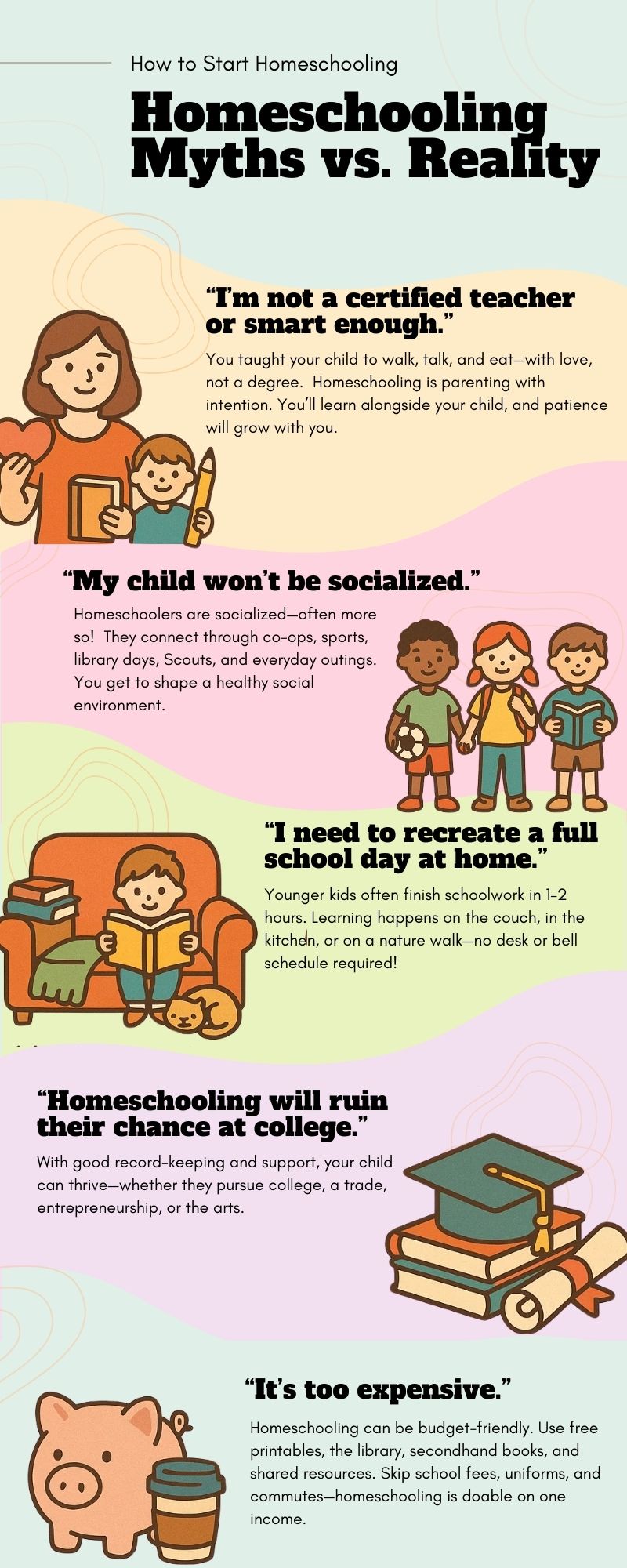
Busting Common Homeschooling Myths and Fears
📌 Even after all your planning, doubts can creep in. That’s totally normal.
Let’s shine a light on those fears and kick them to the curb—because most of them are rooted in old assumptions or worst-case scenarios that rarely come true.
❌ Myth: “I’m not a certified teacher… or patient/smart enough to homeschool.”
✅ Reality: You absolutely do not need a teaching degree to guide your child’s education. Think about all the things you’ve already taught them—how to walk, talk, feed themselves, and so much more. You did that with love, not credentials.
Homeschooling is just a natural extension of parenting. And the good news? There are resources galore—teacher’s guides, answer keys, online tutorials, and supportive communities. You can learn alongside your child. In fact, many parents say they understand things better the second time around.
As for patience? It grows. Like a muscle. And homeschooling will help you build it. None of us starts out perfectly prepared—we grow into the role, one day (and deep breath) at a time.
❌ Myth: “My child won’t be socialized and will miss out on real-world experiences.”
✅ Reality: This is probably the most persistent homeschool myth—and the least true. Homeschooled kids are out in the world all the time: co-ops, sports, Scouts, dance, church, neighborhood play, museum days, volunteer work.
Instead of being confined to one classroom with 25 same-age peers, they interact with people of all ages in real-life settings. And they often develop excellent communication skills and emotional intelligence.
Plus, you get to shape their social environment—no bullying, no peer pressure, just healthy, positive interactions. And trust me, your homeschool calendar might get too full if you say yes to everything. (It’s a thing. Ask any veteran homeschool parent!)
❌ Myth: “I have to recreate a full school day and classroom at home.”
✅ Reality: Please don’t. Homeschooling is way more efficient than traditional school. One-on-one learning means you can move at your child’s pace without all the classroom logistics.
For younger kids, academics might only take 1–2 hours a day. Older students might do focused work for 3–4 hours, with the rest of the time for projects, hobbies, outdoor time, or creative exploration.
Learning doesn’t have to happen in a desk chair from 9 to 3. It can look like reading on the couch, writing in the backyard, or counting seashells on a beach walk. If your “school day” ends before lunch, that’s not failure—it’s freedom.
❌ Myth: “Homeschooling will ruin my child’s chances for college or a normal future.”
✅ Reality: Colleges and employers are more open to homeschoolers than ever. In fact, many universities actively recruit them because they tend to be independent, curious, and self-motivated.
Keeping good records and eventually building a transcript (don’t worry—you’ll get help when the time comes!) is all you need.
And if your child wants “traditional” milestones like prom or graduation? Homeschool communities often organize those, too. Your child’s future is not only intact—it’s full of possibilities, passion projects, and purpose-driven learning.
❌ Myth: “Homeschooling is too expensive—we can’t afford all the books and materials.”
✅ Reality: Homeschooling can be expensive… but it doesn’t have to be. Many families homeschool on a single income with creativity, resourcefulness, and a little online sleuthing.
You can buy secondhand curriculum, download free PDFs, use the library like a pro, and join free resource-sharing groups. Most of what you need is either already in your home—or available for little to no cost.
You’re also skipping things like uniforms, school fees, constant fundraisers, and commuting.
Got another fear whispering in your ear?
Chances are, it’s based on someone else’s “what if” or a bit of outdated thinking. No school path is perfect—not public, not private, not even homeschool. But what homeschooling gives you is flexibility. Connection. The chance to respond to your child’s real needs and passions in real time.
And when in doubt? Reach out. There’s a whole world of homeschoolers (hello, Step 7!) who’ve walked this road and are more than happy to offer reassurance, encouragement, and tips from the trenches.
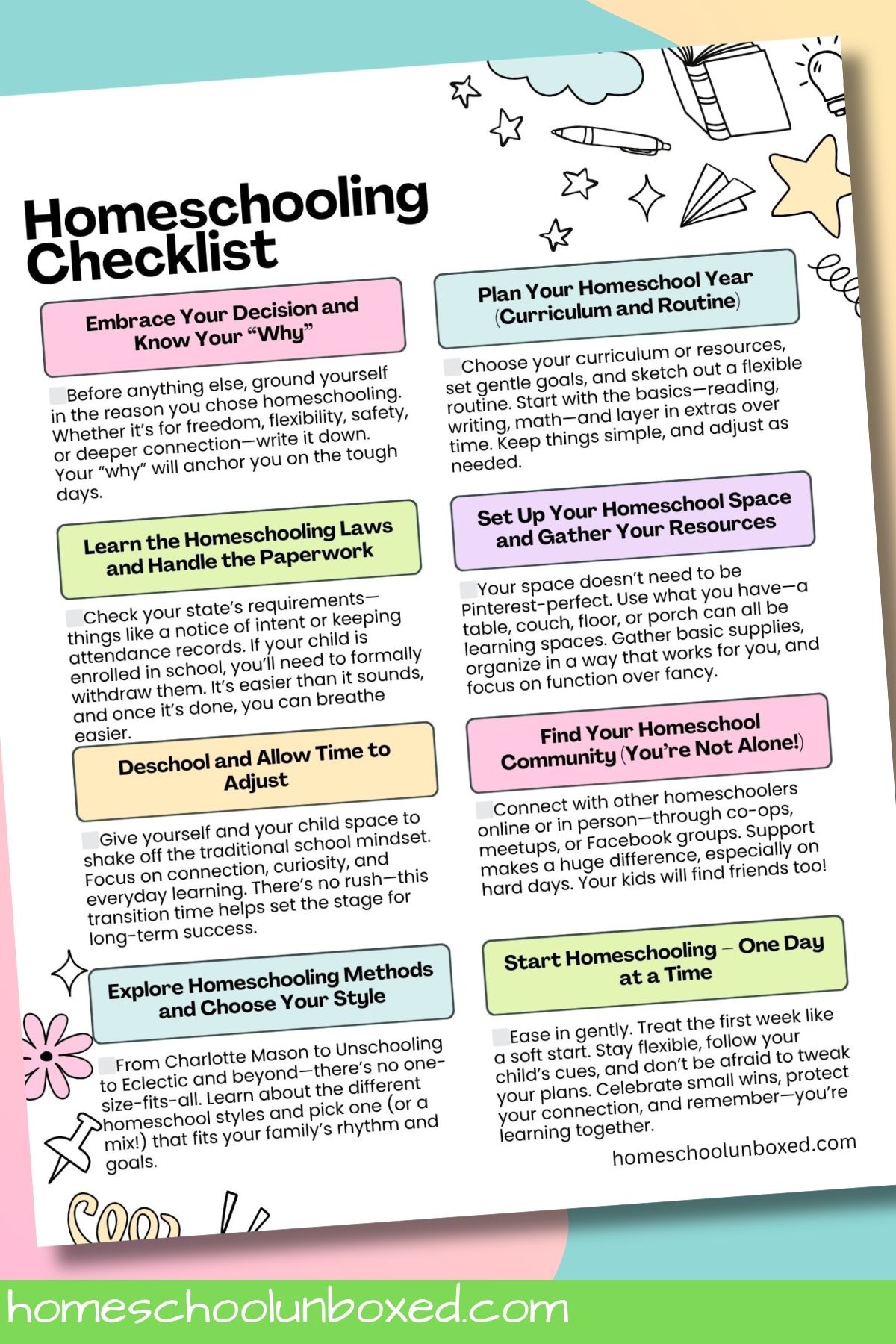
🎁 Grab the Printable!
Want a handy, shareable version of this homeschool myths & realities guide?
Pop your name and email into the blue box below and I’ll send the printable straight to your inbox! ✨
It’s perfect to hang on your fridge, tuck in your planner, or share with a friend who’s thinking about homeschooling.
📌 For personal or classroom use only, please—no commercial redistribution.
You’ve Got This! (Final Encouragement for the Road Ahead)
Imagine yourself a year from now: You’re sipping that coffee (maybe it’s reheated for the third time – homeschool life, I get it!), watching your child curled up with a book they love or excitedly explaining to you how plants grow from the seeds you planted together. You’re hearing them ask curious questions, or seeing them finally conquer that math problem that was once so hard. In that moment, you’ll realize how far you both have come. All the initial worries won’t hold the same power, because you’ll have proven to yourself that you can do this.
Starting homeschooling is a bold choice, but it’s also a beautiful gift you’re giving your family. The days you spend learning side by side will knit you closer together. You’ll share goofy science jokes, discover history facts that amaze you, and probably develop a slight obsession with buying books (occupational hazard!). You’ll also have days where you want to hide in the pantry for a moment of quiet—on those days, remember this seasoned friend’s advice: take it one day at a time. Bad day? Shake it off and know tomorrow is a fresh start. Great day? Celebrate and jot it down to remember later.
Be kind to yourself. Homeschool moms (and dads) can be hard on themselves, always worrying if they’re doing enough. Trust that your love and commitment are the most important ingredients in your child’s education. The fact that you care this much means you’re already a fantastic parent and teacher. You won’t ruin your child by choosing to homeschool—in fact, you’re likely to give them an education tailored to them in a way no one else could.
Stay flexible and keep learning too. Homeschooling will change you in wonderful ways. You might rekindle a love for art when teaching your kids to paint, or finally understand algebra during a review (true story from my life!). Embrace the learning adventure for yourself as well. Your kids will see that learning is a lifelong joy, not just something for school hours.
Cherish the freedom. If something’s not working, you have the freedom to change it. If a sunny day calls for ditching the workbooks and heading to the zoo, you can do that and count it as a field trip. If your child develops a sudden interest in astronomy, you can shuffle plans around to dive into space for a week. These spontaneous, interest-led moments are often where the deepest learning happens. Don’t be afraid to diverge from “the plan” – that plan is yours to modify.
Keep perspective. Homeschooling is a marathon. You don’t have to teach everything today or even this year. Education is a journey that unfolds over time. Some years will be super productive academically; others might be more focused on character, life skills, or family changes (new babies, moving houses – life happens!). It’s all part of the big picture. What matters is that your children are growing, learning, and feeling loved and supported along the way.
Finally, know that you are doing an amazing thing. Not every parent can or will choose this path. It takes courage, dedication, and a big heart. There will be people who don’t understand your choice—that’s okay. Focus on the little hearts and minds in your care. You know what’s best for your family. You’ve prepared, you’ve got resources and support, and you have the passion to give your kids a wonderful education. The impact of that decision will echo in your children’s lives for years to come. You’re raising lifelong learners, and that is something to be incredibly proud of.
So here’s your gentle call to action: take the leap. Start with the first step in this guide and move forward, one step at a time. Lean on this guide, refer back to the interlinked posts when you need more depth, and reach out to your newfound community. You are not alone, and you are fully capable.
Go ahead and mark your calendar for “Day 1” of homeschool, even if it’s just a fun outing or a library day. Take that step. The night before, lay out a book or activity you’re excited about. It’s happening! Nerves and all, you’re doing it.
You’ve got this. Really and truly. Your family’s homeschool journey will have its own unique rhythm and rhyme, and it will be beautiful in its own way. Years from now, you might look back and say, “This was one of the best decisions we ever made.” I certainly feel that way about my own homeschooling adventure.
Now, go forward and start homeschooling with confidence and joy. And when you hit a bump, remember this friend’s voice in your head: You can do this. Because you can, and you will.
Welcome to the homeschool family! 🎉 You’re about to embark on something very special.