How to Use the Socratic Method in Homeschool (Deeper Learning)
If you’ve ever wished your kids would ask why more often—or, maybe they already do, but you want to turn that curiosity into meaningful learning—then the Socratic Method might be just what your homeschool needs! This question-driven approach helps kids think critically, engage deeply with subjects, and develop problem-solving skills that will serve them for life.

So, what exactly is the Socratic Method, and how can you use it in your homeschool? Let’s dive in!
What is the Socratic Method?
The Socratic Method is a teaching approach based on questioning rather than simply providing answers. Instead of saying, “Here’s a fact—remember it,” you encourage your child to think through problems, explore different perspectives, and arrive at conclusions through discussion.
Named after the Greek philosopher Socrates, this method is all about:
✔ Asking open-ended questions
✔ Encouraging thoughtful discussion
✔ Helping kids connect ideas across subjects
✔ Fostering independent thinking
For example, instead of telling your child, “The moon affects the ocean’s tides,” you could ask:
💡 “What do you think would happen to ocean waves if the moon suddenly disappeared?”
Now, instead of memorizing a fact, they are actively thinking through cause and effect!
Why the Socratic Method is Perfect for Homeschooling
One of the biggest perks of homeschooling is the freedom to follow curiosity rather than being tied to a rigid curriculum. Kids don’t have to memorize a list of facts just to check off a box—they can ask real questions, explore ideas, and form their own conclusions. That’s exactly what the Socratic Method is all about!
Unlike a traditional school setting, where a teacher has to balance a full classroom and stick to a strict lesson plan, homeschoolers have the flexibility to slow down, dig deeper, and have real conversations. Whether it’s during a cozy morning read-aloud, a nature walk, or a hands-on science experiment, you can weave Socratic questioning into your day naturally—no special curriculum required.
Here’s why the Socratic Method works so well in a homeschool setting:
✅ Encourages a love of learning – When kids are invited to discover answers rather than being handed them, learning becomes an adventure, not a chore. Instead of asking, “Do I have to learn this?”, they start asking, “What else can I find out?”
✅ Develops critical thinking – In a world full of quick answers and instant information, kids need to know how to think, not just what to think. The Socratic Method teaches them to analyze, evaluate, and reason through problems, making them independent learners for life.
✅ Strengthens communication skills – Whether it’s discussing a history debate, explaining a math concept, or making a case for why they should have extra screen time (😉), kids learn to express and defend their thoughts clearly and respectfully. These skills will serve them well in adulthood—whether in college, careers, or everyday life.
✅ Works with any subject – You don’t have to overhaul your entire homeschool approach to incorporate Socratic questioning. It fits seamlessly into history discussions, science experiments, math problem-solving, literature analysis, and even everyday decision-making. From “Why do you think this character made that choice?” to “What would happen if there were no gravity?”, you can apply this method to anything you’re already teaching.
And best of all? It makes learning fun and engaging! Instead of dry memorization, lessons feel like interactive storytelling, exciting discoveries, and meaningful conversations. Your homeschool becomes a place where curiosity thrives, and your child develops a lifelong love of learning—which, honestly, is the best thing we can give them.
Real-Life Example: A Socratic Homeschool Moment
Imagine you’re sitting outside on a crisp fall morning, sipping your coffee while your child watches a squirrel dart up a tree. Instead of jumping in with “Squirrels collect nuts to prepare for winter,” you ask:
💡 “Why do you think that squirrel is in such a hurry? What might happen if he didn’t store food?”
Before you know it, you’re discussing seasons, food chains, animal instincts, and even survival strategies—all from one simple question. That’s the magic of the Socratic Method! It turns everyday moments into rich learning experiences without worksheets or forced memorization.
So, whether you’re tackling big history debates, scientific discoveries, or just a curious moment in nature, the Socratic Method can make your homeschool more engaging, more interactive, and more meaningful.
How to Use the Socratic Method in Your Homeschool
Here are some simple ways to incorporate Socratic questioning into your homeschool routine, broken down by subject:
🔬 Science: Question-Based Discovery
Instead of saying, “Plants need sunlight to grow,” ask:
💡 “What do you think would happen if we put a plant in a dark closet? Why?”
Then, test it with an experiment!
Other Science Questions to Try:
✔ Why don’t penguins freeze in Antarctica?
✔ How do some animals survive in the desert without water?
✔ Why do volcanoes erupt?
📖 Literature: Digging Deeper into Stories
Instead of asking, “Did you like the book?” try:
💡 “Why do you think the main character made that choice?”
Other Literature Questions to Try:
✔ Would the story change if it were set in a different time period?
✔ Which character’s decisions made the biggest impact on the ending?
✔ What do you think the author wanted us to learn from this book?
🏛️ History: Exploring Perspectives
Instead of saying, “The American Revolution was about taxation without representation,” ask:
💡 “If you were a colonist, would you have joined the revolution? Why or why not?”
Other History Questions to Try:
✔ What do you think daily life was like in Ancient Egypt?
✔ How did geography influence how civilizations developed?
✔ Was it fair for the U.S. to buy land from other nations? Why or why not?
🔢 Math: Teaching Problem-Solving Skills
Instead of just drilling math facts, ask:
💡 “Can you solve this problem in more than one way?”
Other Math Questions to Try:
✔ Why do fractions and decimals represent the same thing?
✔ How would you explain long division to someone who has never seen it before?
✔ Where do we see math in everyday life?
🎨 Art & Creativity: Thinking Like an Innovator
Instead of saying, “That’s a nice painting,” ask:
💡 “What feeling were you trying to express in this artwork?”
Other Creativity Questions to Try:
✔ If you could invent anything, what would it be?
✔ How do artists use colors to create moods?
✔ What makes something “art” in the first place?
Tips for Success with the Socratic Method in Your Homeschool
The Socratic Method is a powerful tool, but it takes a little practice—both for you and your child! At first, kids might be used to looking for the “right answer” instead of thinking through their ideas. That’s okay! The key is to create an environment where curiosity thrives and kids feel comfortable expressing their thoughts.
Here are a few simple ways to make Socratic questioning a natural and effective part of your homeschool:
Be patient!
Some kids need time to process their thoughts, especially if they’re not used to being asked open-ended questions. If you ask, “Why do you think the sky changes colors at sunset?” and your child stares at you blankly for a moment, resist the urge to jump in with hints or answers.
Instead, give them space to think. Sometimes, a few moments of silence are all they need to start forming their own ideas. If they still seem stuck, try rewording the question: “What do you notice about the sky in the morning compared to the evening?”
📌 Pro Tip: If your child struggles with verbalizing thoughts, let them draw their ideas, act them out, or write them down first. Not all thinking has to happen out loud!
Ask follow-up questions.
Sometimes kids will give short or vague answers—especially if they’re used to traditional “yes/no” or “fact-based” questions. Instead of moving on, encourage deeper thinking with follow-up questions.
If they say, “I think the character made a bad choice,” try asking:
💡 “What do you mean by ‘bad choice’? Can you explain more about why you think that?”
💡 “How do you think the story would change if they made a different decision?”
Follow-up questions help kids go beyond surface-level thinking and truly engage with the material. Plus, it shows them that their thoughts matter—which builds confidence in their ability to express and defend their ideas.
📌 Pro Tip: Some of the best follow-up questions start with:
- “What do you mean by that?”
- “Can you give me an example?”
- “How would you explain this to someone younger than you?”
Don’t worry about “wrong” answers.
One of the biggest shifts in using the Socratic Method is letting go of the idea that there’s always a “right” answer. In a typical classroom, kids are trained to find the correct response as quickly as possible—but real learning happens when they think through ideas, make connections, and explore possibilities.
If your child answers something that seems “wrong” or off-track, resist the urge to correct them right away. Instead, try saying:
💡 “That’s an interesting perspective! What made you think of that?”
💡 “Hmm, that’s one possibility. Can you think of another way to look at it?”
This approach keeps the conversation open rather than shutting it down. It also encourages kids to analyze their own thinking and refine their ideas.
📌 Pro Tip: If your child comes to an incorrect conclusion but works through the reasoning process, that’s still a success! The goal isn’t just knowledge—it’s developing a habit of thinking critically.
Make it part of your daily routine!
You don’t have to set aside a separate “Socratic Method” time in your homeschool—this approach fits naturally into everyday life!
Here are a few easy ways to incorporate Socratic questioning into daily routines:
🏡 During Read-Aloud Time:
Instead of just reading a book and moving on, pause to ask:
💡 “What do you think this character will do next?”
💡 “If you were in this situation, how would you react?”
🌿 On a Nature Walk:
Use curiosity-driven questions to spark discussion:
💡 “Why do you think some trees lose their leaves while others don’t?”
💡 “How do you think animals survive in the winter?”
🍳 While Cooking Together:
Turn cooking into a mini science and math lesson:
💡 “Why do you think flour and water make dough?”
💡 “How would this recipe change if we doubled all the ingredients?”
🚗 In the Car:
Car rides are a great time for big discussions! Try asking:
💡 “If you could live in any time period, when would it be and why?”
💡 “What do you think would happen if we suddenly had no electricity?”
📌 Pro Tip: If your child resists these types of conversations, start by modeling the process with your own thinking. Say something like:
“I was just thinking… how do bees know how to build hexagons in their honeycombs? What do you think?”
This shows kids that curiosity isn’t just something we ask of them—it’s part of how we all learn and grow!
The Socratic Method is less about “getting it right” and more about building a thinking habit. Some days, your child might have deep, thoughtful responses—other days, they might just shrug and say, “I don’t know.” That’s okay! The more you practice, the easier these conversations will become.
Start small. Pick one subject, ask a few open-ended questions, and see where the conversation takes you. Before long, you’ll start seeing your child thinking more deeply, asking bigger questions, and engaging with learning in a whole new way!
Grab Our Free Printable: A Year of Inquiry-Based Learning with the Socratic Method!
Want to make it even easier to bring inquiry-based learning into your homeschool? We’ve got you covered!
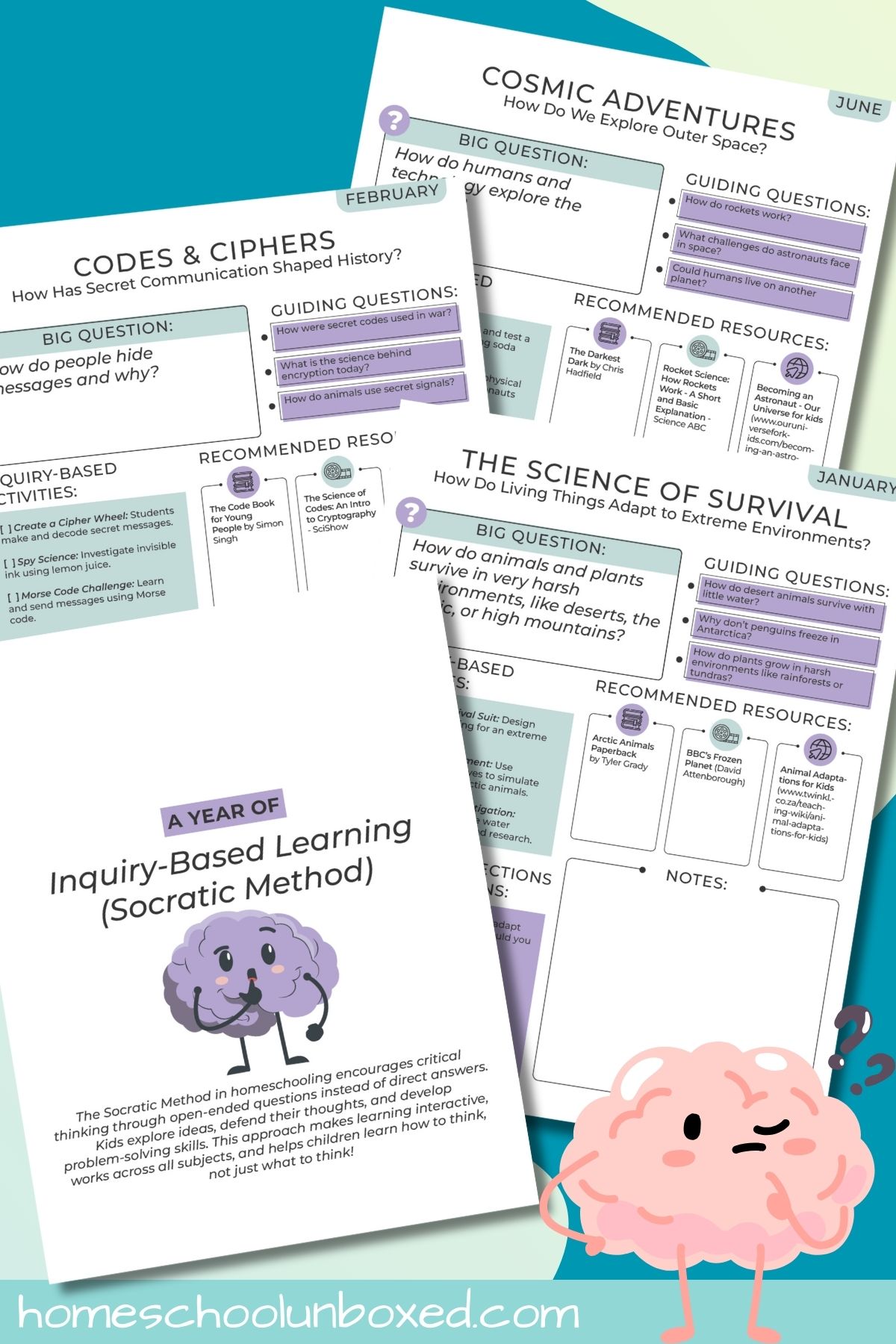
✨ Download our FREE printable: A Year of Inquiry-Based Learning with the Socratic Method! This ready-to-use resource includes:
✅ 12 months of inquiry-based learning themes
✅ Big questions to spark curiosity and discussion
✅ Guiding questions to help kids think critically
✅ Engaging hands-on activities for each month
✅ Book & video recommendations to deepen learning
With this printable, you’ll have a structured yet flexible way to incorporate the Socratic Method into your homeschool—without feeling overwhelmed!
To grab the free printable put your name and email in the box below and we’ll send it straight to your inbox.
The Socratic Method isn’t just a teaching strategy—it’s a mindset shift that transforms learning from passive memorization into active discovery. When you invite your child to ask questions, explore ideas, and think critically, you’re not just helping them understand school subjects—you’re equipping them with the skills to navigate life.
The best part? You don’t need a special curriculum or a formal lesson plan to start using Socratic questioning in your homeschool. Simply start with one question today—whether it’s during a read-aloud, a science experiment, or a walk outside—and see where the conversation takes you. Over time, these little moments of inquiry will add up to a deeper, more engaging homeschool experience.