Soil Vocabulary Worksheets (Free Printable)
This soil vocabulary worksheet is a free printable resource designed to help kids explore and review key soil science terms in a meaningful, hands-on way. It’s perfect for homeschool science lessons or Earth Day activities and includes both a reference page and a matching activity.
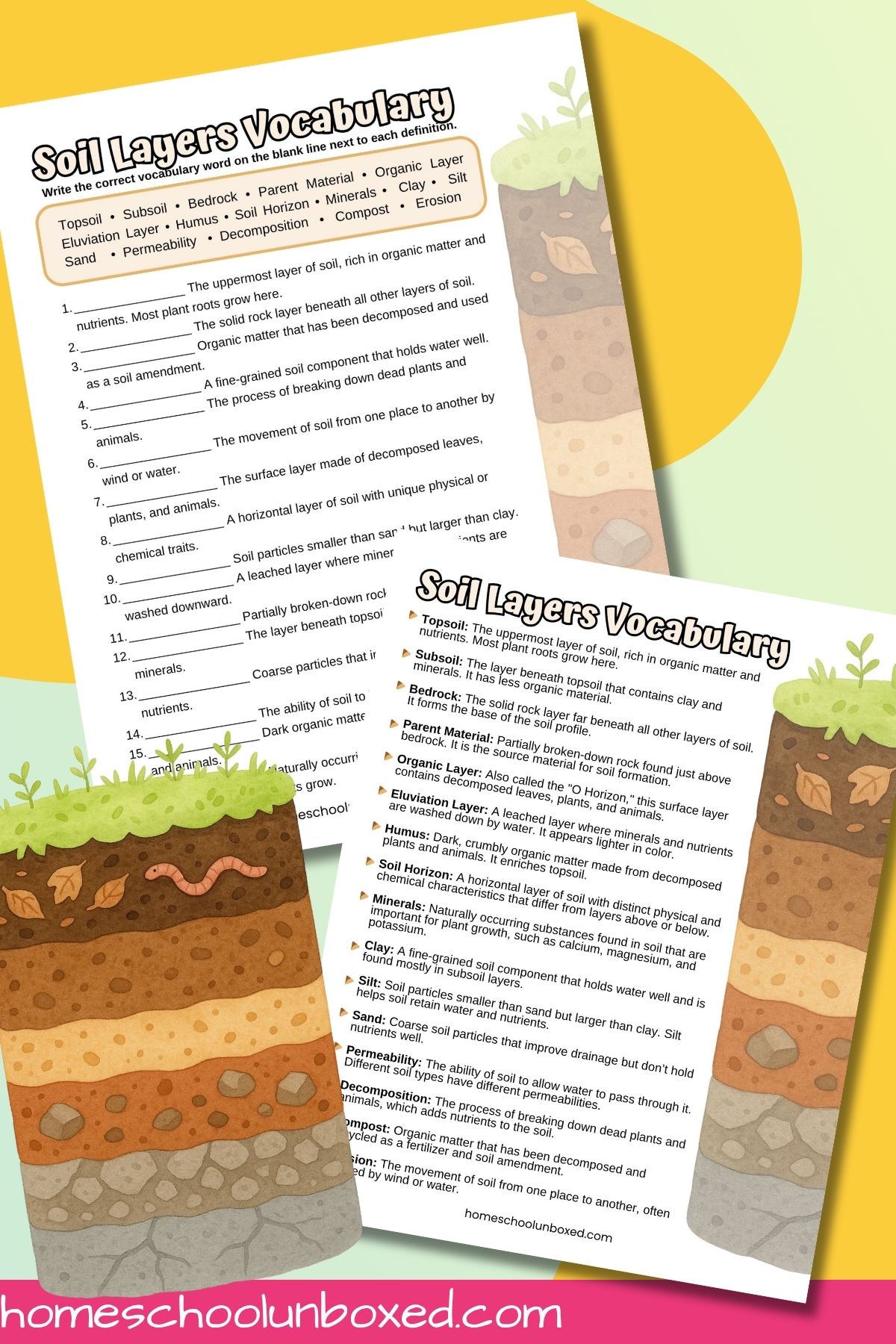
Learning about soil layers doesn’t have to be dry memorization—it can be a creative way to explore how the Earth works right beneath our feet. This soil vocabulary worksheet makes that learning hands-on, engaging, and easy to understand.
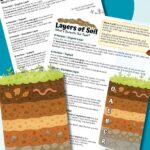
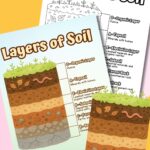
This printable set includes a full-color vocabulary reference sheet with 16 essential soil terms and is ideal for grades 2-5. Students then use the companion worksheet to match each definition to the correct word using a helpful word bank.
To introduce key concepts before diving into vocabulary, consider starting with our Layers of Soil Fact Sheet Printable. It’s a great way to lay the groundwork for understanding soil structure and terminology. If your learners are visual thinkers, they’ll also benefit from the Layers of Soil Diagram Printable, which helps illustrate the soil layers they’ll be learning about.
✂️ Materials
- Printed copies of both the vocabulary reference sheet and worksheet
- Pencil or pen
- Optional: crayons or colored pencils for highlighting or illustrating

📄 The Printable
This set includes:
- A vibrant Soil Layers Vocabulary Reference Sheet with 16 essential soil terms like topsoil, humus, erosion, permeability, and more.
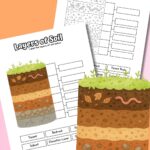
- A Soil Vocabulary Matching Worksheet with clear, student-friendly definitions and a word bank.
- Space for students to complete an optional extension activity, such as writing sentences or drawing illustrations for selected terms.
Both pages are available in full color and are designed for elementary-aged learners.

📘 Vocabulary Words & Definitions
Here are the 16 vocabulary terms featured in the worksheet set:
Topsoil: The uppermost layer of soil, rich in organic matter and nutrients. Most plant roots grow here.
Subsoil: The layer beneath topsoil that contains clay and minerals. It has less organic material.
Bedrock: The solid rock layer far beneath all other layers of soil. It forms the base of the soil profile.
Parent Material: Partially broken-down rock found just above bedrock. It is the source material for soil formation.
Organic Layer: Also called the “O Horizon,” this surface layer contains decomposed leaves, plants, and animals.
Eluviation Layer: A leached layer where minerals and nutrients are washed down by water. It appears lighter in color.
Humus: Dark, crumbly organic matter made from decomposed plants and animals. It enriches topsoil.
Soil Horizon: A horizontal layer of soil with distinct physical and chemical characteristics that differ from layers above or below.
Minerals: Naturally occurring substances found in soil that are important for plant growth, such as calcium, magnesium, and potassium.
Clay: A fine-grained soil component that holds water well and is found mostly in subsoil layers.
Silt: Soil particles smaller than sand but larger than clay. Silt helps soil retain water and nutrients.
Sand: Coarse soil particles that improve drainage but don’t hold nutrients well.
Permeability: The ability of soil to allow water to pass through it. Different soil types have different permeabilities.
Decomposition: The process of breaking down dead plants and animals, which adds nutrients to the soil.
Compost: Organic matter that has been decomposed and recycled as a fertilizer and soil amendment.
Erosion: The movement of soil from one place to another, often caused by wind or water.
If you want to bring the vocabulary to life, try pairing it with our Layers of Soil Fold-Out Worksheet. It’s a fun cut-and-paste activity that lets kids build a physical model of the soil layers.
🛠️ How to Use
- Start by reading through the Soil Layers Vocabulary Reference Sheet with your child or students.
- Print the worksheet and have learners read each definition carefully.
- Using the word bank, students will write the correct soil term on each blank.
- Encourage them to complete the extension activity by writing sentences or drawing a diagram for one of the words.
- Review answers together or use the reference sheet for self-checking.
To build out your soil unit study, pair this worksheet with the Soil Layers Diorama Printable, where students can build their own 3D model of the soil layers. For a final review or quick assessment, use the Soil Layers Labeling Worksheet to let kids apply their knowledge visually.
🎓 Educational Uses/Tips
- 🧠 Vocabulary Practice: Reinforces science language in a structured, approachable way.
- 📘 Science Journals: Print and have students glue both pages into their notebooks.
- ✍️ Writing Integration: Use terms like “humus” or “erosion” as writing prompts or journal entries.
- 🌎 Earth Day Tie-In: Include this worksheet in your Earth Day activities as a way to reflect on the importance of healthy soil.
📥 Grab the Printable
Ready to dig into soil science vocabulary? 🌱 Enter your name and email in the blue box below to get your free Soil Vocabulary Worksheet Set—perfect for personal or classroom use.
📌 These printables are for personal and single classroom use only. Please do not resell or redistribute.
Whether you’re kicking off a full soil unit or just want a low-prep way to boost vocabulary retention, this soil vocabulary worksheet set offers a stress-free, print-and-go option that makes learning stick. Pair it with hands-on soil crafts or a nature walk, and you’ve got a science lesson kids will actually remember!
You’ve got this—just print, teach, and watch their understanding grow. 🌾